
When the first preview of Hardwood’s writer shipped with 1.1.0.Beta1, it came with two notable gaps: it was single-threaded, and it couldn’t write to S3. Both are closed now, and I’m happy to announce the first release candidate for Hardwood 1.1!
Besides rounding out the writer, this release brings support for the latest Parquet file format additions (ALP encoding, FILE logical type),
and it substantially improves the performance of local as well as remote file reads.
We’ve also hardened the reader against untrusted files and set up a nightly benchmark suite for catching performance regressions.
You can fetch the Hardwood library JARs from Maven Central. Binaries for the Hardwood CLI are available on the GitHub releases page. Let’s dig in!
Writing to S3 and Parallel Writes
Just like Hardwood’s reader, which had S3 support early on, the writer can now write Parquet files directly to S3 and S3-compatible object stores.
The S3Source object which you already use for reading has been expanded to hand out output files, too:
 1
 2
 3
 4
 5
 6
 7
 8
 9
10
11
12
13
14
15
16
17
18
List<Event> events = ...;

try (S3Source s3 = S3Source.builder()
        .region("eu-west-1")
        .credentials(S3Credentials.of(accessKeyId, secretKey))
        .build();
     ParquetFileWriter writer = ParquetFileWriter.create(
         s3.outputFile("s3://my-bucket/events/2026-11.parquet"), (1)
         schema)) {

    RowWriter rows = writer.rowWriter();
    for (Event event : events) {
        rows.writeRow(row -> row
                .setDate("day", event.day())
                .setLong("id", event.id())
                .setString("payload", event.payload()));
    }
} (2)
| 1 | An OutputFile for the given S3 object |
| 2 | The object becomes visible at the key when the writer is closed |
Larger files are streamed to S3 as a multipart upload while they are written:
whenever a part (8 MiB by default, configurable via uploadPartSize()) is full, it is uploaded in the background,
with up to four uploads in flight while the writer continues with the next part.
The second big change to the writer is that it now makes use of multiple CPU cores.
When a row group is flushed, its column chunks are encoded and compressed in parallel.
By default, the writer uses one thread per available processor.
If you want to control the number of threads, or share one thread pool between several writers and readers,
pass a HardwoodContext when creating the writer, e.g. HardwoodContext.create(4) to use up to four threads,
or create(0) to run all encoding and decoding work on the calling thread.
Further Writer Additions
Some other writer additions made it into this release:
-
For codecs like
ZSTDyou can now set the compression level, allowing you to trade write time for file size. -
If your rows are sorted, you can declare the sort order via
sortingColumns(). It is recorded in the metadata of each row group, so that query engines can take advantage of it. The writer verifies the declared order as rows come in, failing the write when a row is out of order. -
Optionally, data pages can be written in the
DATA_PAGE_V2format, which keeps repetition and definition levels uncompressed and states each page’s row count in its header, letting readers skip pages or locate nulls without decompressing them.
1
2
3
4
5
6
7
WriterConfig config = WriterConfig.builder()
        .compression(Compression.zstd().level(9)) (1)
        .sortingColumns( (2)
                SortingColumn.ascending("vendor", NULLS_LAST),
                SortingColumn.descending("pickup_ts", NULLS_LAST))
        .dataPageVersion(DataPageVersion.V2) (3)
        .build();
| 1 | ZSTD at level 9 instead of the default level 3 |
| 2 | Rows are sorted by vendor, and by pickup time within each vendor |
| 3 | Write DATA_PAGE_V2 pages instead of DATA_PAGE |
Finally, StructBuilder.setValue() accepts values in the form the reader’s getValue() returns them,
making it easy to copy rows from one file to another without having to dispatch on each field’s type.
New Format Features
Hardwood 1.1.0.CR1 supports two recent additions to the Parquet format specification.
First, ALP (Adaptive Lossless Floating-Point), a new encoding for FLOAT and DOUBLE columns:
Many floating-point values in practice are decimals with a fixed, small number of fractional digits, such as prices or sensor measurements. ALP multiplies such values by a power of ten, turning for instance 12.34 into the integer 1234, and bit-packs these integers relative to the smallest one of each block of 1,024 values, so that the closer together the values of a block are, the fewer bits each one takes up. Values which can’t be represented that way are stored as-is, so the encoding is lossless.
ALP is currently marked as a preview feature in the Parquet spec, so make sure your consumers can read it before using it. Hardwood reads ALP-encoded columns, and writes them when requested:
1
2
3
WriterConfig config = WriterConfig.builder()
    .encoding("latitude", ColumnEncoding.ALP)
    .build();
In a quick test, I rewrote the latitude and longitude columns of a sample of 3.75M rows from the GBIF species occurrence data set with Hardwood. Here are the sizes of the two columns, compared to the original files:
| File | Encoding | Codec | Size |
|---|---|---|---|
Original GBIF files |
Dictionary, falling back to |
Snappy |
53.9 MB |
Hardwood, default |
Dictionary, falling back to |
ZSTD |
36.6 MB |
Hardwood, ALP |
ALP |
ZSTD |
27.0 MB |
Hardwood, ALP |
ALP |
none |
27.0 MB |
Compared to Hardwood’s default encoding, ALP takes up 26% less space in this particular case. Writing the two columns into an in-memory file is five times faster with ALP and no compression1 than with the default encoding and ZSTD (85 ms vs. 443 ms), and reading them back almost four times faster (20 ms vs. 77 ms), measured on my little N300 box. That said, ALP isn’t a good fit for all kinds of floating-point data: columns with comparatively few distinct values are typically better served by dictionary encoding, so measure which columns benefit and enable ALP for those.
Second, the new FILE logical type for a group describing a binary object, such as an image or a PDF document,
either stored inline or in external storage, referenced by a URI (optionally with an offset and size, e.g. pointing to an entry in a larger archive).
Hardwood reads such groups as validated PqFile objects, and writes them via setFile().
Besides these spec additions, Hardwood now also supports field ids (as used by Apache Iceberg, Delta Lake and DuckLake to identify columns independently of their names),
which are exposed on ColumnSchema and SchemaNode, can be set when building a schema, and are retained when rewriting a file.
Performance Improvements
To enable further improvements to Hardwood’s performance,
we have decided to completely rethink how the fetching and decoding of pages is organized within the read engine.
The idea is simple: a read is now split into small jobs, such as fetching a byte range or decoding a page.
They are executed by a scheduler, which runs them in the order of the rows they serve.
Fetching happens on virtual threads and decoding on the thread pool of the read’s HardwoodContext, so neither has to wait for the other.
And as requests are capped at 16 MiB, decoding starts as soon as the first chunk of a column has arrived, keeping all cores busy.
Further improvements include:
-
An S3 object of up to 256 KiB is read in the single request which opens it; for larger files, the footer and the page index usually come with that first request
-
Multi-file reads open the next files ahead of time, fetching their footers and first data while earlier files are still being read
-
Uncompressed fixed-width values are read in place from the page, and row readers projecting only flat columns take a faster path
-
Batches, dictionaries and decompressed pages no longer become humongous G1 objects on heaps below 4 GB, avoiding the associated GC overhead
To spot regressions early, we set up an automated performance benchmark suite. It runs every night, recording wall-clock time, CPU time, allocations and peak live set of each scenario, and uses Apache Otava to detect change points in the resulting time series, which are published on the benchmark results page.
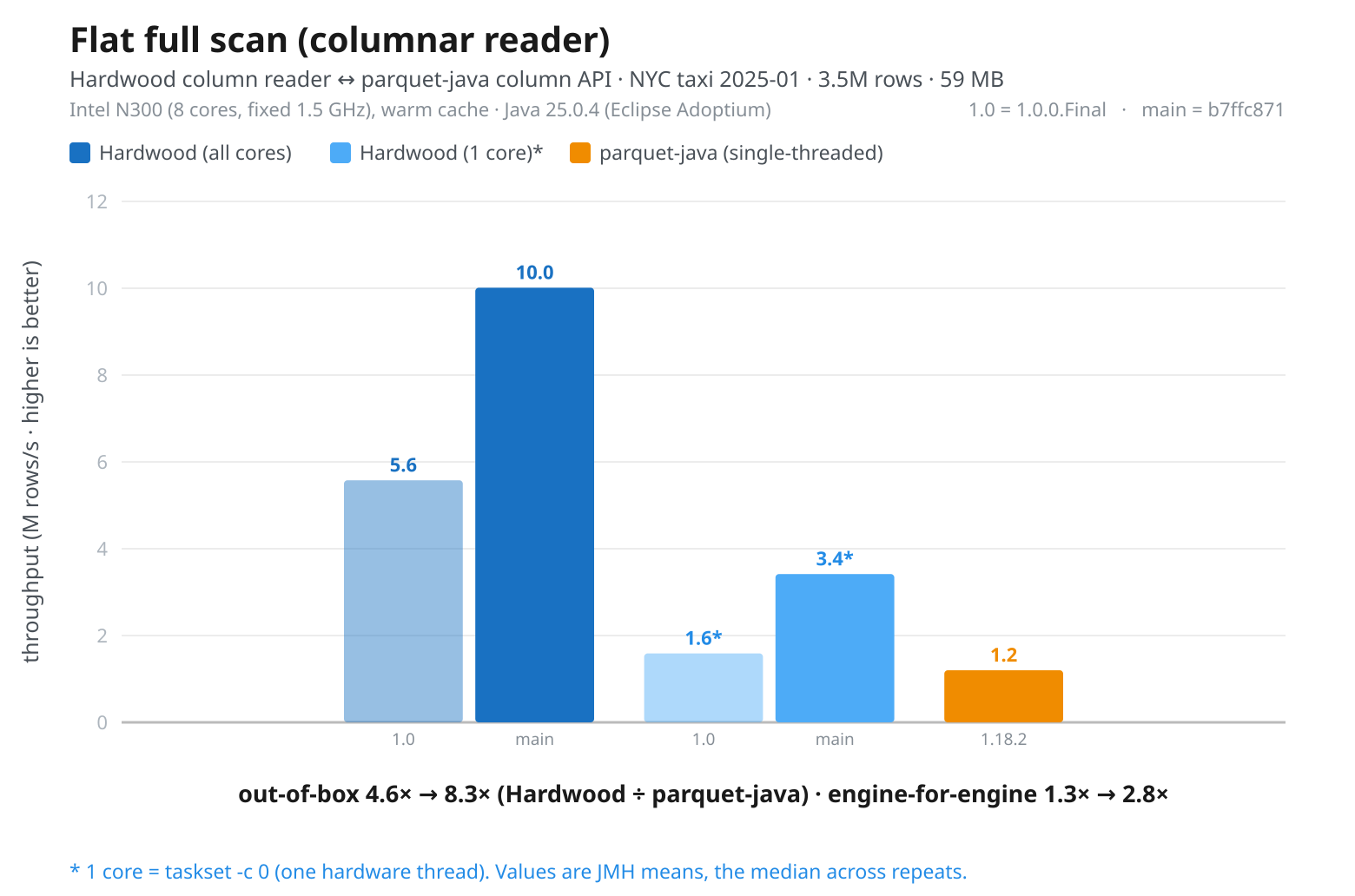
I recently also re-ran the benchmarks from the 1.0 announcement on the N300, comparing Hardwood 1.0 and a recent development snapshot against the latest parquet-java (1.18.2). A full scan with the column reader is now 1.8× faster than with Hardwood 1.0, and more than twice as fast when limited to a single core:
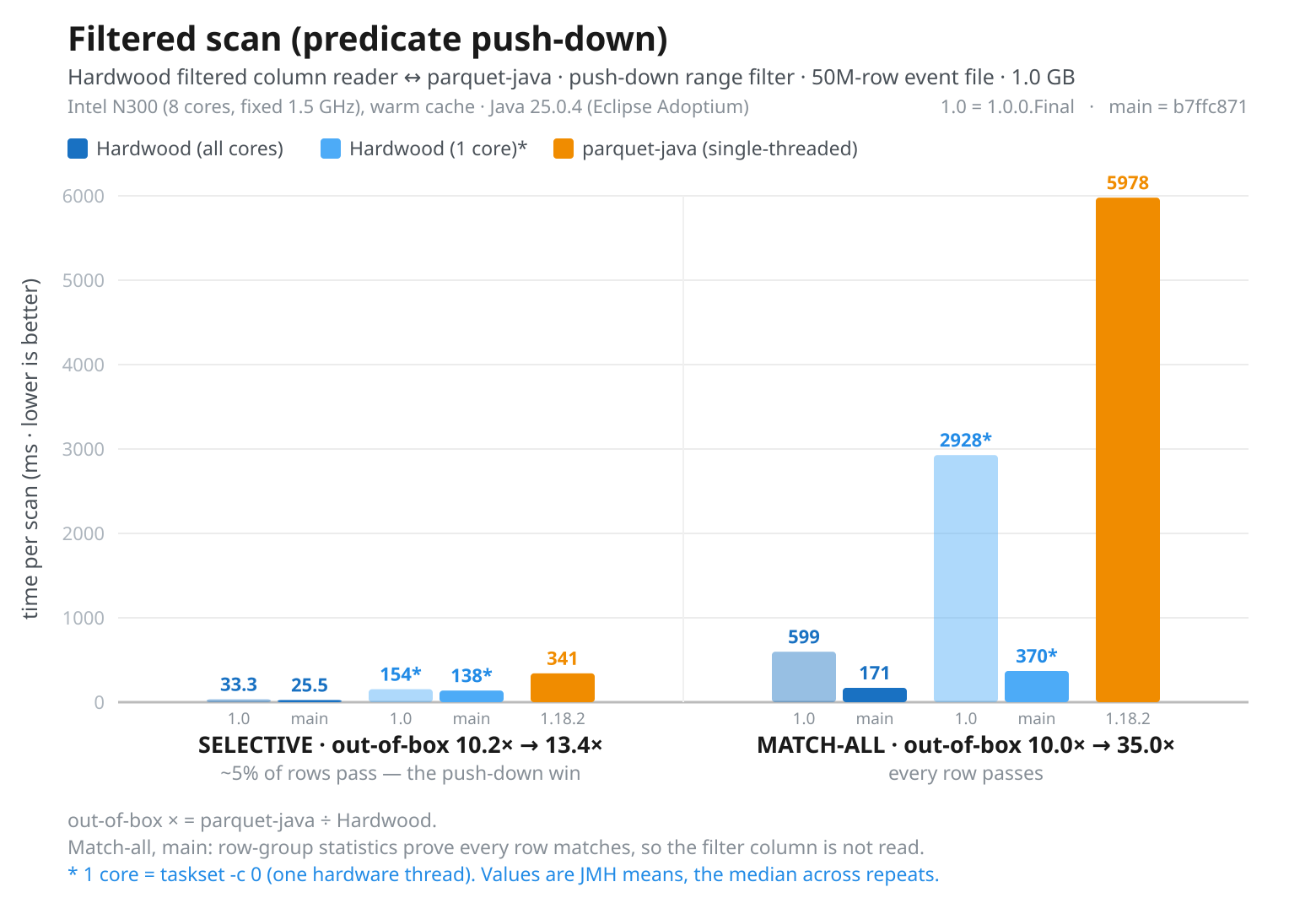
Filtered scans benefit too: on one core, a scan of 50M rows where every row matches went from 2.9 s to 0.37 s, as the filter column can be skipped when row-group statistics show that all rows match (raw data and scripts):
As always, these are numbers from specific workloads on one specific machine, so you should do your own testing too.
Also in This Release
To harden reads of untrusted files, the reader now validates every size, count and length a file declares before allocating anything based on it,
failing with a ParquetReadException instead of allocating without bound.
The parsing of footers and page headers, page decoding, and decompression are fuzzed with Jazzer.
Other notable changes include:
-
Reads fail with an exception instead of hanging when they can no longer make progress, e.g. after running out of heap
-
S3: public buckets can be read without credentials (
S3Source.Builder.anonymous()), a read fails if the object was replaced after opening, and stalled responses are retried -
Fixes for shredded Variants and for files using the deprecated
BIT_PACKEDlevel encoding -
CLI:
--log-filecaptures detailed logs, such as the byte ranges fetched from S3, and S3 reads fall back to unsigned requests when no credentials are configured -
CLI releases ship with checksums and build provenance attestations, verifiable via
gh attestation verify
This release contains a few breaking changes, most notably the new LogicalType.FileType and Encoding.ALP, which require an additional case in exhaustive switch statements over these types,
and the new fieldId component of ColumnSchema and SchemaNode.GroupNode, so that schemas which differ only in their field ids are no longer equal.
If you’ve used the writer of the 1.1 preview releases, note that WriterConfig now takes a Compression object and FileSchema.Builder and StructBuilder declare leaf columns via primitive(…).
Check out the release notes for details,
and the API changes report for all changes to the public API.
See the 1.1.0.CR1 milestone for all 157 resolved issues.
Wrapping Up
A big thank you to everyone who contributed to this release: Alex Petrov, Alex Sorokoumov, André Rouél, Arnab Nandy, Chandan Dhamande, Fawzi Essam, Jeronimo López, Manish, Matt Van Horn, Matthew Mullett, Omar Abdelmawgoud, ommkd, Perfloop Agent, and Rion Williams.
As for next steps, we’re planning to release a second candidate in about two weeks, with the public API of Hardwood 1.1 in its final shape, followed by Hardwood 1.1.0.Final as an early Christmas present before the holidays.
Beyond that, Hardwood 1.2 will bring a higher-level API for copying and transforming Parquet files,
which copies unchanged data as-is and only re-encodes what a transformation touches,
e.g. for compacting small files or dropping a column.
Other potential additions include support for Parquet modular encryption, a strict memory quota for reads, and several additions around the VARIANT column type.
Until then, please give the release candidate a try, in particular the new writer features such as writing to S3, and let us know your feedback via GitHub issues and discussions!