
I am happy to announce the release of Hardwood 1.0.0.CR1!
This first candidate release of Hardwood 1.0 brings a substantially improved API for columnar access to Apache Parquet files,
initial support for Parquet’s GEOMETRY/GEOGRAPHY column types, and many other improvements to the core library as well as the Hardwood CLI.
Reworked ColumnReader API
Hardwood provides two APIs for parsing Parquet files:
-
The
RowReaderAPI provides row-oriented access to Parquet records, including nested structs, lists, and maps. Optimized for ergonomics and ease of use, it is the recommended general-purpose API for reading arbitrarily complex structured records one by one -
The
ColumnReaderAPI offers batch-style access to the columnar data of a Parquet file; it is optimized for throughput and the preferred choice for analytical workloads that operate on large numbers of values
For the 1.0.0.CR1 release, we’ve reworked the columnar API to close some gaps around the retrieval of optional and repeatable columns and make the API less error-prone to use.
Taking inspiration from Apache Arrow’s columnar format for nested data,
we introduced a new type, Validity, to model nullability across both flat and nested data.
Let’s take a look at some examples.
First, here’s how to sum all the values from a flat (i.e. non-nested and non-repeatable) column:
 1
 2
 3
 4
 5
 6
 7
 8
 9
10
11
12
13
14
15
16
17
ParquetFileReader reader = ...;

try (ColumnReader fare = reader.columnReader("fare_amount")) { (1)
    double sum = 0;
    while (fare.nextBatch()) {
        int count = fare.getValueCount();
        double[] values = fare.getDoubles(); (2)
        Validity validity = fare.getLeafValidity();
        boolean hasNulls = validity.hasNulls(); (3)

        for (int i = 0; i < count; i++) { (4)
            if (!hasNulls || validity.isNotNull(i)) {
                sum += values[i];
            }
        }
    }
}
| 1 | Create a column reader by name (spans all row groups automatically) |
| 2 | Get the values from the current batch as double |
| 3 | Hoisting the hasNulls() check outside the loop increases throughput if most batches don’t have nulls |
| 4 | Process the values from the current batch |
When reading multiple columns from a file,
you can obtain a ColumnReaders object which lets you drive the readers in lockstep:
 1
 2
 3
 4
 5
 6
 7
 8
 9
10
11
12
13
14
15
16
17
18
19
20
21
ParquetFileReader reader = ...;
long passengerCount = 0;
double tripDistance = 0, fareAmount = 0;

ColumnReaders columns = reader.buildColumnReaders(
        ColumnProjection.columns(
                "passenger_count", "trip_distance", "fare_amount"))
        .build();

while (columns.nextBatch()) {
    int count = columns.getRecordCount();
    long[]   v0 = columns.getColumnReader("passenger_count").getLongs();
    double[] v1 = columns.getColumnReader("trip_distance").getDoubles();
    double[] v2 = columns.getColumnReader("fare_amount").getDoubles();

    for (int i = 0; i < count; i++) {
        passengerCount += v0[i];
        tripDistance += v1[i];
        fareAmount += v2[i];
    }
}
Parquet also allows for repeatable columns (i.e. lists) and even nested repeatable columns (i.e. lists of lists). The column reader API captures the nullability of these structures through a notion of layers — telling you which elements at each level of nesting are null, say an outermost list, a list nested within it, or a leaf value inside a list. Here is an example of a dataset which contains multiple temperature measurements per day, and we’d like to calculate the mean daily maximum:
 1
 2
 3
 4
 5
 6
 7
 8
 9
10
11
12
13
14
15
16
17
18
19
20
21
22
23
24
25
26
27
28
29
30
31
// temperature_samples is a list<double> — each record holds one day's
// readings. Mean daily maximum: the average, across days, of each day's
// hottest reading.
ColumnReader col = reader.columnReader(
        "temperature_samples.list.element"); (1)
double sumOfMaxima = 0;
long days = 0;

while (col.nextBatch()) {
    int records = col.getRecordCount();
    double[] readings = col.getDoubles();
    int[] offsets = col.getLayerOffsets(0); (2)
    Validity present = col.getLayerValidity(0); (3)
    Validity valid = col.getLeafValidity(); (4)

    for (int r = 0; r < records; r++) {
        if (present.isNull(r)) continue; (5)

        double dailyMax = Double.NEGATIVE_INFINITY;
        for (int i = offsets[r]; i < offsets[r + 1]; i++) { (6)
            if (valid.isNull(i)) continue;
            if (readings[i] > dailyMax) dailyMax = readings[i];
        }
        if (dailyMax != Double.NEGATIVE_INFINITY) { (7)
            sumOfMaxima += dailyMax;
            days++;
        }
    }
}
System.out.printf("Mean daily maximum: %.1f °C over %d days%n",
        sumOfMaxima / days, days);
| 1 | Open a column reader on the list’s leaf, element |
| 2 | Per-list boundaries: record r’s readings run from `offsets[r] up to (excluding) offsets[r + 1] |
| 3 | List-level validity — which records actually logged a day, versus a null list |
| 4 | Leaf-level validity — which individual readings within those lists are non-null |
| 5 | Skip null lists; the layer model keeps this per-record check separate from element nulls |
| 6 | Reduce each list within its own span — a per-list max can’t be recovered from one flat array of every reading |
| 7 | Left at -inf by an empty list (or one whose readings were all null), so those days don’t count |
Handing values back as contiguous primitive arrays plus a set-bit-means-present validity bitmap is also exactly the shape vectorized processing wants:
callers can run branch-free, data-parallel loops over the values (e.g. with Java’s Vector API).
The how-to guide covers the API in depth:
multi-level nesting, efficient retrieval of repeatable String values,
working effectively with sparse columns, and more.
Note that the ColumnReader API is marked experimental in Hardwood 1.0:
there may be changes—potentially backwards-incompatible ones—in response to the feedback we receive.
We’re planning to promote the API to stable in a future Hardwood 1.x version.
Geospatial Support
Via its GEOMETRY and GEOGRAPHY logical types,
Apache Parquet allows you to store geospatial data using the Well-Known Binary (WKB) serialization.
Both column types are supported by Hardwood as of this release,
and their geospatial statistics drive predicate push-down to the row group and page level.
Geospatial data is currently exposed as raw byte arrays,
so you can use a geometry library of your choice (e.g. JTS) for decoding:
 1
 2
 3
 4
 5
 6
 7
 8
 9
10
11
12
13
14
ParquetFileReader fileReader = ...;

FilterPredicate filter = FilterPredicate.intersects(
        "location", -25.0, 35.0, 45.0, 72.0); (1)

WKBReader wkbReader = new WKBReader(); (2)

RowReader rowReader = fileReader.buildRowReader().filter(filter).build();

while (rowReader.hasNext()) {
    rowReader.next();
    byte[] wkb = rowReader.getBinary("location");
    Geometry geom = wkbReader.read(wkb); (3)
}
| 1 | Filter records by intersecting with the given bounding box; note this applies at the row group / page level, i.e. a record will be returned if there’s at least one match in the same page or row group |
| 2 | Decode the raw bytes with any WKB library — here JTS' WKBReader |
| 3 | The decoded Geometry is ready to inspect, intersect, etc. |
Documentation Overhaul
As we’re approaching the Hardwood 1.0 release, we’ve also spent some time improving and completing the project documentation. We’re big fans of the Diátaxis approach for structuring technical documentation, which proposes to organize docs in four distinct categories: tutorials (learning-oriented), how-to guides (goal-oriented), reference (information-oriented), and explanation (understanding-oriented). The docs on hardwood.dev have been restructured and built out based on this framework:
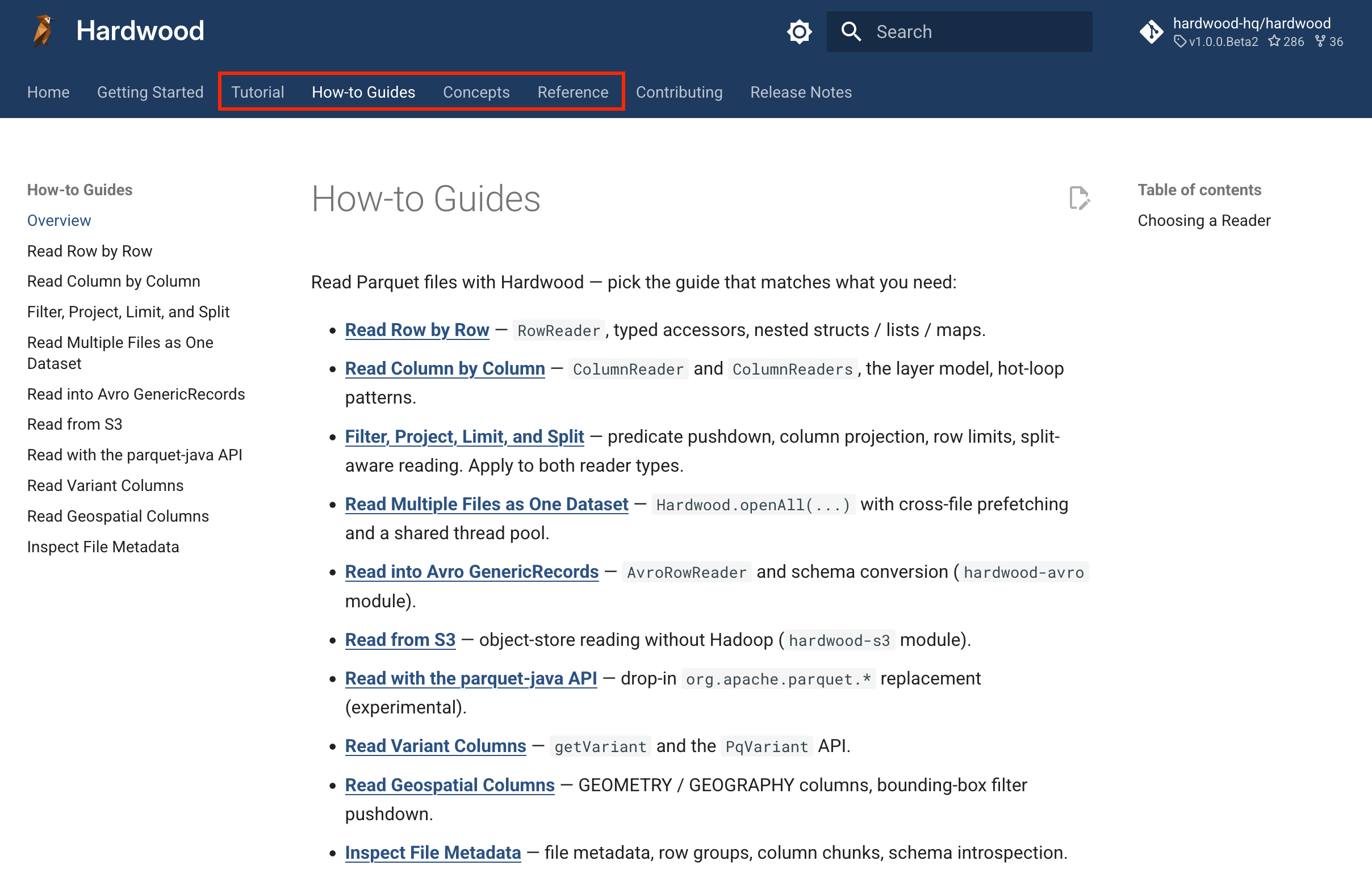
We hope that Hardwood users will find it much easier now to get started with the library, solve specific tasks such as reading files on S3, or learn more about Hardwood’s concurrency model. Any feedback on the new documentation structure is more than welcome!
Further Fixes and Improvements
In addition, Hardwood 1.0.0.CR1 contains a number of other changes:
-
Local files of arbitrary size can be parsed, as long as individual column chunks don’t exceed 2 GB; for remote files (e.g. on S3), the 2 GB total file size limit remains in place
-
Hardwood now supports Parquet’s
FLOAT16column type -
The
RowReadervalue model gained more ergonomic accessors: by-index field access onPqStruct, key-based lookup and typed accessors onPqMap, typedListaccessors onPqList, and additional Variant accessors -
Multi-column filter expressions are now evaluated more efficiently by pushing as much work as possible to individual page decoder threads
-
To distribute work across cluster engines such as Apache Flink, Hardwood now supports split-aware reading via
RowGroupPredicate.byteRange(…), allowing the row groups of a file to be processed by multiple worker instances -
Exhaustive logical-type formatting in the Hardwood CLI; faster navigation of large collections and corrected "go to latest" in the data preview of
hardwood dive
Overall, 50 issues were resolved for Hardwood 1.0.0.CR1; see the release notes and the GitHub milestone for the complete list. The Hardwood library artifacts (hardwood-core, hardwood-s3, etc.) are available on Maven Central, while platform-specific native binaries for the Hardwood CLI can be downloaded from the 1.0.0.CR1 release page.
As always, a massive shout-out to everyone who contributed to this release: Carlos Sousa, Fawzi Essam, Manish, Mohamed Ibrahim Elsawy, Muhannd Sayed, polo, Prashant Khanal, Rion Williams, and Said Boudjelda!
With 1.0.0.CR1 out the door, we’re on the home stretch to Hardwood 1.0 Final, which should ship in a week or so. After that, we’ll begin work on writing Parquet files, slated for Hardwood 1.1 in early summer.